A test brand, not a coffee launch
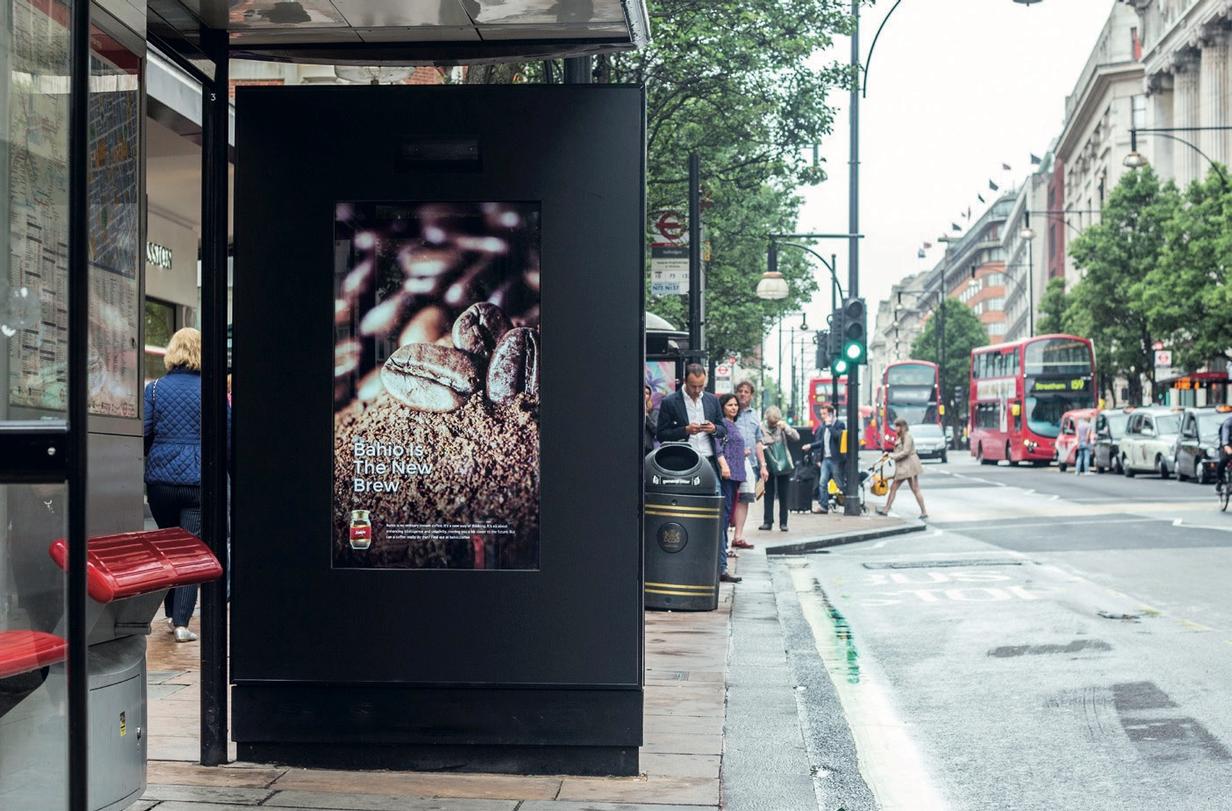
Bahio was a fictional coffee brand used in M&C Saatchi’s 2015 London billboard experiment. Directory dates the campaign to July and records placements on Oxford Street and, subsequently, Clapham Common. The agency’s own case film was published on July 10. That publication date is not presented here as a verified first day on the street.
The useful question is not whether a computer could become a coffee marketer. It is whether the unit of creative work could change: from approving one poster to defining a space of possible posters and a procedure for choosing among them.
What was actually evolving?
The campaign record describes an algorithm that recombined copy, layout, typography and images. Camera-derived response signals informed which executions survived, with some random mutation introducing variation. This is evolutionary optimization of supplied ingredients, not a contemporary text-to-image model inventing a photograph from a prompt.
That distinction changes where an editor should look for authorship. Whoever defines the available ingredients and the selection criterion has already made consequential creative decisions. A system can explore a design space vigorously while remaining unable to question whether that space contains a worthwhile proposition.
Attention is a proxy, not a verdict
An attention signal cannot, on its own, tell an advertiser why somebody stopped looking. Confusion, amusement, irritation and interest could all matter differently to the business. Treating every favorable sensor score as persuasion would collapse those distinctions. This is an evaluation concern, not a finding that the Bahio system misclassified a particular person.
A stronger assessment would separate visibility, message comprehension and remembered brand meaning, then compare the adaptive system with an appropriate fixed-design baseline. It would also explain what was sensed, what was retained and what people nearby were told. Those questions belong beside the creative output, not in a footnote after the technology story.
The lasting lesson: design the objective
Read this as a field experiment in delegated selection. The linked record contains activity counts and preliminary observations, but those are not evidence of incremental sales. No commercial lift is claimed in this entry, and the campaign’s historical superlatives are not adopted as independently established facts.
For a present-day team, the practical lesson is to document the allowed components, the optimization target and the stopping rule before celebrating variation. Keep representative failures as well as winners. A changing poster can make the process visible; it cannot make the choice of objective neutral. The archive value lies in that shift of responsibility, not in imagining that human judgment disappeared.
Sources & limits
Agency film and agency-credited campaign record; experimental deployment, not verified sales effectiveness
- Artificially Intelligent Poster — M&C Saatchi London — 10 July 2015.
- London’s First Artificial Intelligence Poster Campaign — Directory, issue 37 — source publication date not stated.
Send a correction with the passage and supporting source.