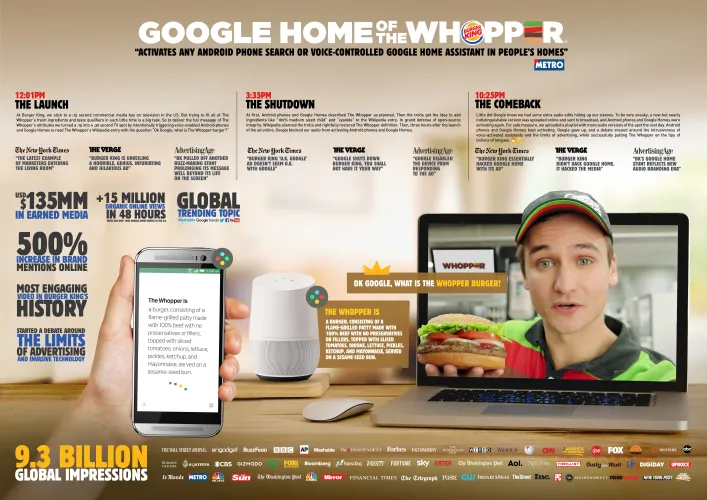
Reported execution: a television ad tried to continue in the room
The 2017 Clio record credits Burger King and DAVID Miami for Google Home of The Whopper. Ogilvy's retrospective describes it as a television spot that used a voice-activated assistant to extend the product message. The central move was direct: the on-screen speaker said the wake phrase and asked what a Whopper was, anticipating an assistant within earshot.
That makes the assistant a live part of the placement rather than a product shown in a conventional commercial. The campaign's edge came from treating a household device as an unexpected audience and distribution channel.
Our reading: the joke depended on a boundary
A voice interface is intimate precisely because it is supposed to respond to the person in the room. Turning a broadcast into a command can create instant attention, but it also changes the consent boundary. The cleverness and the irritation are the same mechanism seen from opposite sides.
That tension is why this is more useful as a historical case than as a repeatable tactic. A voice moment should earn its interruption with a clear service, choice or invitation. Surprise alone ages quickly when the audience feels a device has been recruited without them.
What a current brief should specify
Write the interaction as a complete journey: trigger, response, recovery and opt-out. Check what happens when the assistant cannot understand the phrase, when a household has more than one device, or when platform behaviour changes after the spot is delivered. A campaign cannot assume control of another company's interface.
Teams should also separate a product fact from a third-party knowledge source. If the response draws on an editable or changing source, the advertiser has ceded an important part of the claim. That needs legal and brand review before launch, not after social response arrives.
Evidence boundary: attention is not permission
Award records establish the execution and credits, and agency retrospectives establish how the idea was framed. They do not provide a neutral measure of sales effect or a complete account of every affected user.
The record supports a narrower conclusion: speech recognition became the campaign's medium and its controversy. It does not establish that commandeering an assistant is an effective or acceptable default for voice advertising.
Sources & limits
Agency retrospective and Clio award record; this archive does not treat earned-media figures as independently audited.
- The Clios — Google Home of The Whopper — source publication date not stated.
- Ogilvy — Google Home of The Whopper — source publication date not stated.
Send a correction with the passage and supporting source.