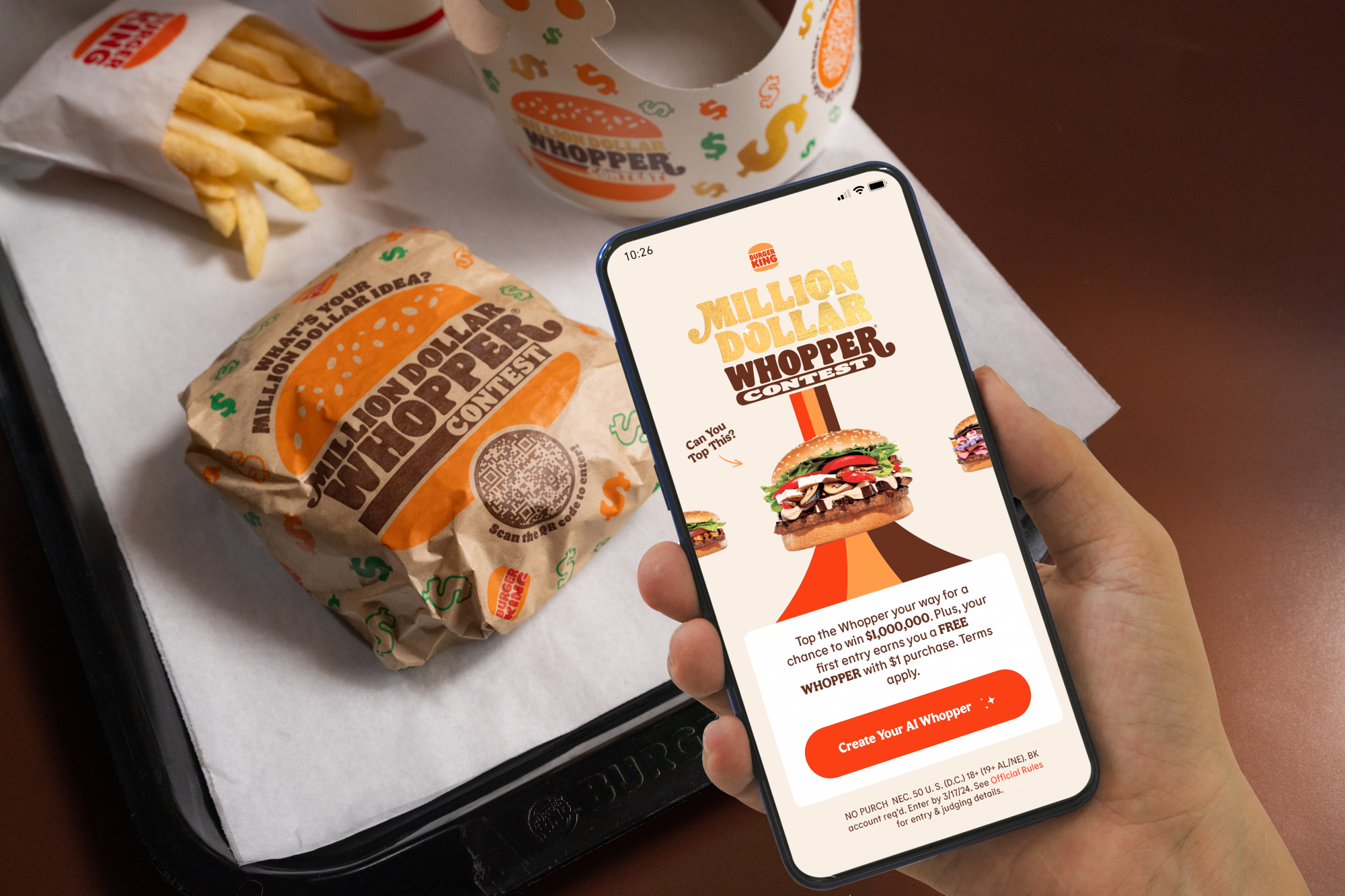
Reported execution: AI was the sketchbook, not the menu
Burger King announced the Million Dollar Whopper Contest on February 5, 2024. A Royal Perks member could submit a dream Whopper of up to eight toppings through the app or site. The release says the system then supplied an AI preview, personalized jingle and themed background for a shareable image or video.
The public route did not end at that generated presentation. Burger King said three concepts would be selected by judges, refined with finalists at its Miami headquarters, then appear in restaurants before a public vote. The image could express an appetite, while ingredient feasibility and the retail choice stayed in a human process.
Our reading: generation earns its place when it makes authorship visible
The campaign’s useful device is not a photoreal burger by itself. It turns a text-like recipe submission into something a participant can recognize as theirs and circulate. The branded output acts as a receipt for a small act of invention, giving a contest entry more presence than a confirmation screen.
That is also a narrower claim than ‘AI designed the next Whopper.’ The food proposition comes from the guest and must eventually survive culinary work. Keeping those stages distinct protects both the participant’s authorship and the brand’s responsibility for what reaches a restaurant.
Production lesson: design the handoff between fantasy and fulfillment
A food preview can accidentally promise an impossible stack, unavailable ingredient or misleading portion. A brief built on this mechanic needs a plain boundary between illustrative output and the eligible topping list. It should also retain the submitted recipe as the authoritative record rather than treating the generated picture as an order specification.
The contest path is the stronger operational model. Declare who can select, revise and reject an idea; provide the finalist with a way to understand changes; and version the approved concept before it becomes media. Generative polish is then in service of participation instead of becoming an unaccountable product claim.
Evidence boundary: a participation flow is not a product-development study
Burger King’s release documents the intended mechanics and scheduled stages. It does not independently demonstrate how faithfully the previews represented submissions, whether sharing changed participation, or what share of entries could plausibly be made. This record therefore does not attribute menu results to the image generator.
A useful evaluation would separate completed entries, shares, finalist conversion and later customer preference, while also checking representation errors in the visual output. The durable lesson is procedural: a generated artifact can make a public call for ideas feel personal when humans still own the safety, feasibility and final selection.
Sources & limits
Contemporaneous Burger King newsroom release; mechanics and dates are first-party, not an independent measure of contest or sales impact.
- Burger King — Million Dollar Whopper Contest announcement — 5 February 2024.
- Burger King — Million Dollar Whopper Q&A — 28 February 2024.
Send a correction with the passage and supporting source.