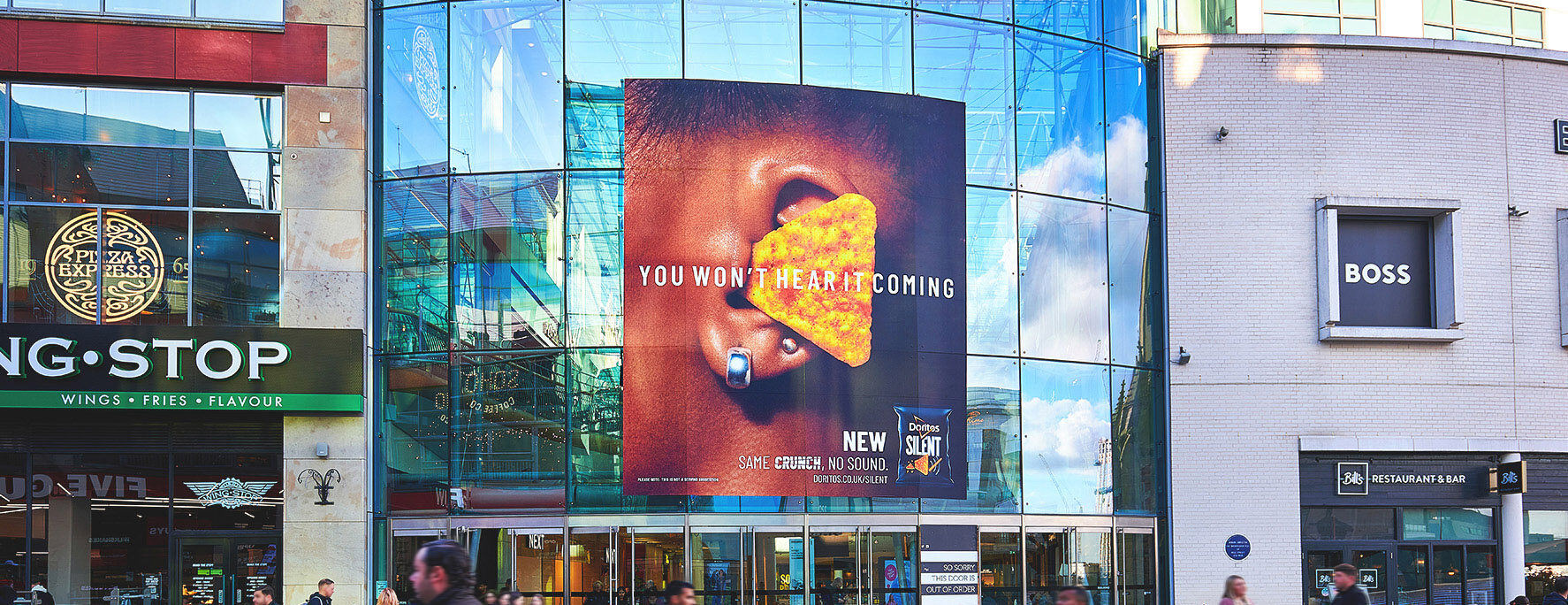
Reported execution: the impossible snack was a software reveal
PepsiCo announced Doritos Silent on November 1, 2023 as free PC software intended to remove crunching noise from voice chat and other calls. The release says it was developed with Smooth Technology over six months through technical analysis of more than 5,000 crunch sounds. The product tease suggested a ‘silent’ Doritos; the reveal directed people to the download instead.
Talon’s campaign case study documents the accompanying outdoor work: Piccadilly Lights, banners, murals and prOOH made the deliberately implausible snack visible before the software explanation. That gives the activation two linked components: an audio-processing utility and an advertising fiction designed to earn attention for it.
Our reading: a product contradiction can clarify the benefit
Doritos is culturally associated with loud crunch. Promising the opposite creates a useful question that ordinary product copy would struggle to generate: how can a chip be silent? The answer shifts the brand from food formulation to a tool that changes what fellow players hear.
The trick only works if the reveal is clear. A consumer should not be left believing there is a physical noiseless product, and the software should be described as changing captured or transmitted sound rather than changing the eater or the chip itself.
Production lesson: test noise reduction without swallowing the speaker
Audio suppression has to distinguish crunches from speech, laughter, keyboards and room noise across microphones, accents and gaming setups. Provide a simple enable/disable control, clear processing expectations and a route for users when performance degrades. The campaign sources describe development and availability, not a full technical evaluation.
The media idea needs the same disclosure discipline. Teaser placement, reveal timing and landing-page language should make the fictional ‘Silent’ snack legible as a route to software, especially in markets where a product claim could otherwise be misunderstood.
Evidence boundary: campaign outcomes need separate verification
PepsiCo’s dated release directly supports the software launch and the stated sound-analysis process. Talon reports campaign reach, uplift and visits, but those figures are agency-reported rather than independent measures of software quality or gamer satisfaction.
This is a strong archive case because AI or algorithmic audio processing was the actual promoted utility, not decorative AI language. What remains unproven publicly is how accurately it worked in everyday calls and whether the advertising effect persisted after the novelty of the reveal.
Sources & limits
PepsiCo’s dated press release and Talon OOH agency case study; reported reach and brand-lift figures remain campaign claims.
- PepsiCo — Doritos Silent brings crunch-cancelling tech to PC gamers — 1 November 2023.
- Talon — Doritos Silent OOH — source publication date not stated.
Send a correction with the passage and supporting source.