Reported execution: put the proposition in a single line
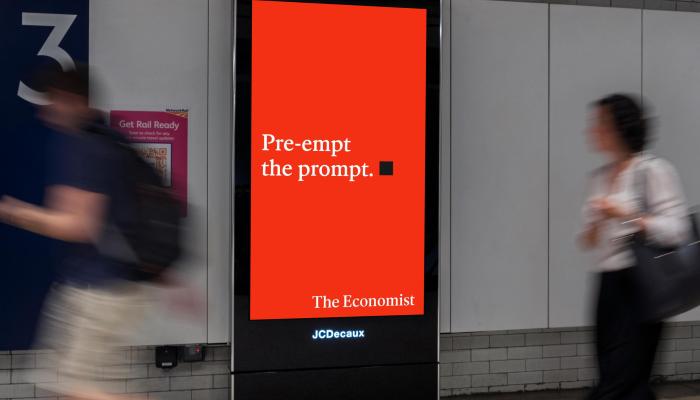
AdNews describes a Cocogun campaign running across key sites in New York, Chicago and London in The Economist’s signature white-on-red style. Lines include ‘Think outside the bot’, ‘Authentic Intelligence’ and ‘Be wise beyond your peers’; JCDecaux documents a related rail wave with ‘Pre-empt the prompt’ and ‘Tricky questions tend to arrive ahead of schedule.’
The campaign makes the publication’s editorial promise the contrast to AI-era information overload. It does not sell a new AI feature or claim that the work itself was generated by AI.
Our reading: a medium can carry the argument
The copy is doing more than decorating a brand platform. Physical OOH becomes a deliberate answer to a web full of cheap, abundant and easily accepted output, while the publication’s value is framed as context, judgement and a reason to pause.
This is a useful counter-position to AI-themed advertising that reaches for spectacle. The idea is memorable because the red field, the short line and the placement all insist on the same behaviour: stop and think.
Production lesson: build a system that can hold many sharp lines
Copy-led OOH works when the campaign has a repeatable grammar but each placement earns its place. A line about prompts belongs near the information environment it is critiquing; a line about opinion or questions can do different work in a different context.
The reusable workflow is to define the brand’s point of view, write a large set of concise propositions, test them for clarity and tone, then match the strongest lines to locations rather than treating every surface as a resized master.
Evidence boundary: documented placement is not documented lift
The cited media-owner and trade sources establish the creative system, agency, locations and timing. They do not provide a controlled measure of attention, subscriber growth, brand lift or the effect of the AI framing itself.
This record supports a creative-positioning lesson: in an AI-saturated category, human judgement can become a specific brand promise. It does not claim that minimal OOH will reliably outperform more generated or media-heavy work.
Sources & limits
JCDecaux’s 21 July 2026 placement release, AdNews’ 7 July coverage and Creative Bloq’s 10 July report document the work and locations; no independent effectiveness study is treated as established here.
- AdNews — Sydney’s Cocogun creates smart one liners for The Economist in the US and UK — 7 July 2026.
- JCDecaux UK — The Economist highlights truth in an AI world — 21 July 2026.
- Creative Bloq — The Economist shades AI in sharp new billboard ads — 10 July 2026.
Send a correction with the passage and supporting source.