Reported execution: the error is the media idea
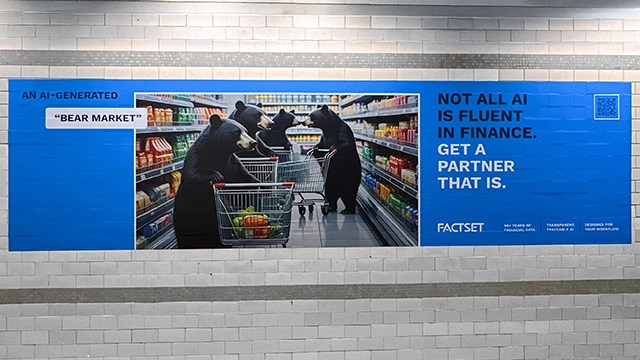
Adweek and OOH Today describe a VSA Partners campaign in which AI-generated images intentionally misunderstand finance. The public examples turn phrases such as ‘bear market’ into literal or awkward scenes, making the gap between generic fluency and institutional-finance nuance the thing people stop to inspect.
The work ran in New York out-of-home placements associated with the city’s finance audience. Instead of hiding the model’s weakness, the campaign makes the weakness an easily read demonstration of why domain context matters.
Our reading: a model failure can be useful when the brief owns it
AI mistakes usually damage an ad when they are accidental. Here, the mistake is bounded, selected and paired with a product reason to care. The audience does not need to trust the image; it needs to notice that generic pattern-matching is a poor substitute for financial fluency.
That reversal also keeps the brand’s expertise central. FactSet is not selling an aesthetic of AI; it is selling the value of data, context and interpretation around a market where words carry specific meanings.
Production lesson: curate the wrong answers like any other proof
An error-led campaign still needs a human review pass. Each image must be legible as an intentional example, safe to place in public and accurate enough that the audience understands the distinction being made.
The reusable workflow is to define the domain phrase, generate the naive reading, fact-check the contrast and write the human takeaway. Without that final step, the campaign risks showing random nonsense rather than a useful boundary.
Evidence boundary: documented intent is not measured impact
The cited trade coverage and brand post document the campaign’s concept, agency and placement context. They do not provide controlled recall, brand lift, lead or sales data.
This is therefore a creative-strategy record. Its evidence supports the use of intentionally imperfect generation as a message about domain expertise, not a claim that visible AI errors reliably improve attention or conversion.
Sources & limits
Adweek and OOH Today coverage, alongside public FactSet/VSA posts, document the creative intent and placements; the sources do not establish campaign effectiveness.
- Adweek — FactSet launches bold OOH campaign designed to stop New Yorkers in their tracks — 13 January 2026.
- OOH TODAY — Designed to Stop New Yorkers in Their Tracks — 14 January 2026.
- FactSet — Wall Street campaign post — source publication date not stated.
Send a correction with the passage and supporting source.