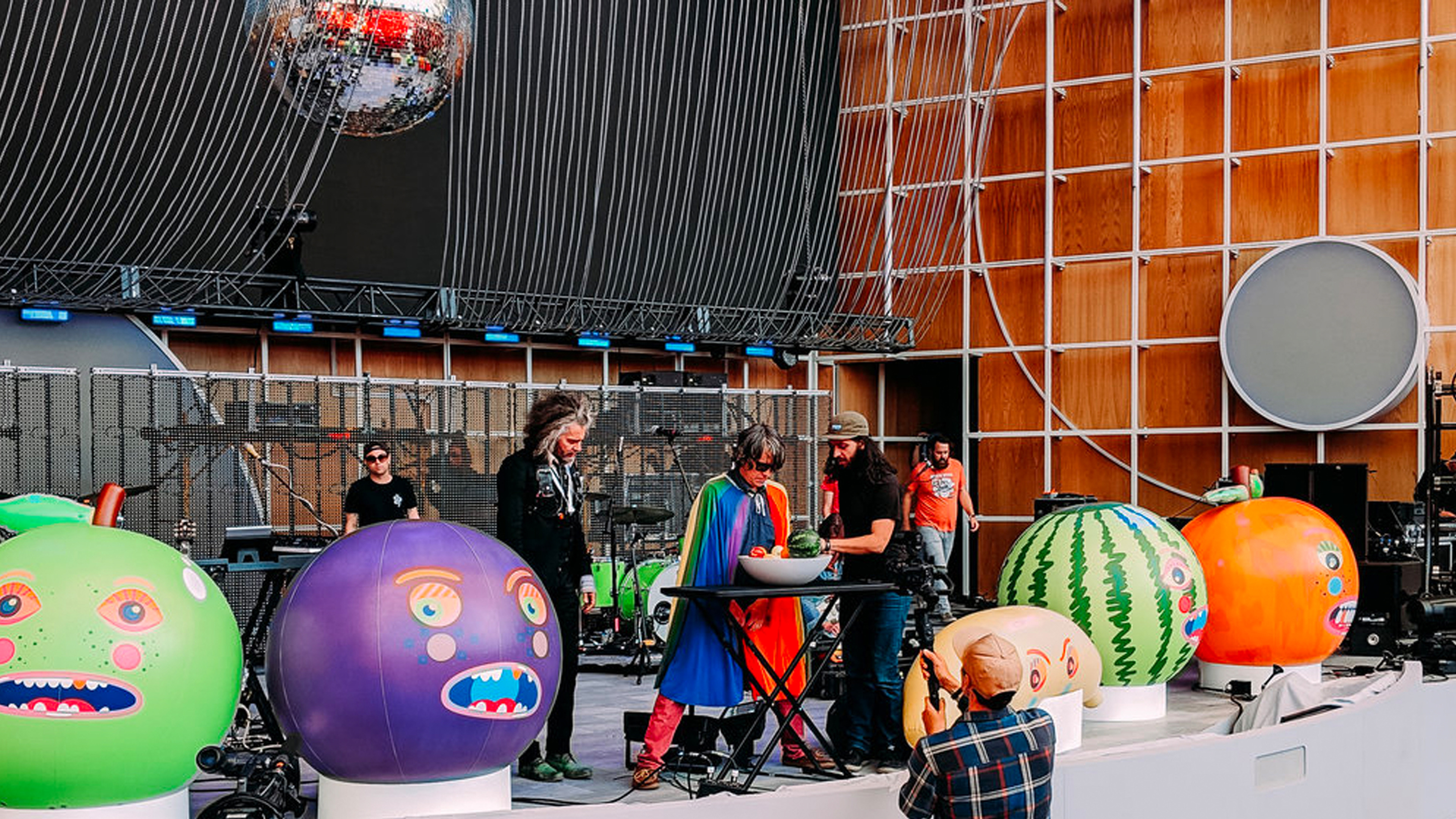
Reported execution: fruit sent notes to the model
WPP records Fruit Genie as a Google I/O 2019 performance with The Flaming Lips, Deeplocal and Google’s Magenta team. Piano Genie, a machine-learning composition tool, received MIDI signals from a bowl of fruit engineered as buttons. Sensor-filled inflatables let the crowd add notes to the same song.
The AI role is bounded and audible. It shaped musical possibilities in a live performance rather than being attached as an abstract innovation claim.
Our reading: the interface made the model social
A bowl of fruit is intentionally unserious, which helps turn a technical demo into a shared invitation. The physical interface gives an audience something visible to touch and watch, while the model supplies a response that is more than a fixed soundboard.
That does not make the system a band member with independent intent. The musicians, engineers and crowd set the conditions under which its outputs became a song.
Evidence boundary: a memorable demo is not proof of creative replacement
The WPP case establishes the partners, model and event mechanics, but it does not measure whether AI composition improved the performance or made people value the brand differently.
This is best retained as a documented live-experience pattern: make an AI system understandable through a human-scale interface, then credit the people who make the encounter meaningful. The approach also demands technical rehearsal: latency, input failure and the musical rules should be tested before a crowd is asked to co-author a public performance. Participation is strongest when it has a legible effect. In this case the reported chain is unusually concrete: sensors converted audience actions into MIDI input, Piano Genie turned those signals into playable musical choices, and performers carried the outcome into a shared live set. That makes the model’s role inspectable rather than merely decorative.
Sources & limits
WPP agency case study; it documents the event mechanism, not a measured advertising-effect result.
- WPP — Google I/O The Flaming Lips — source publication date not stated.
Send a correction with the passage and supporting source.