Reported execution: a painting became the campaign artifact
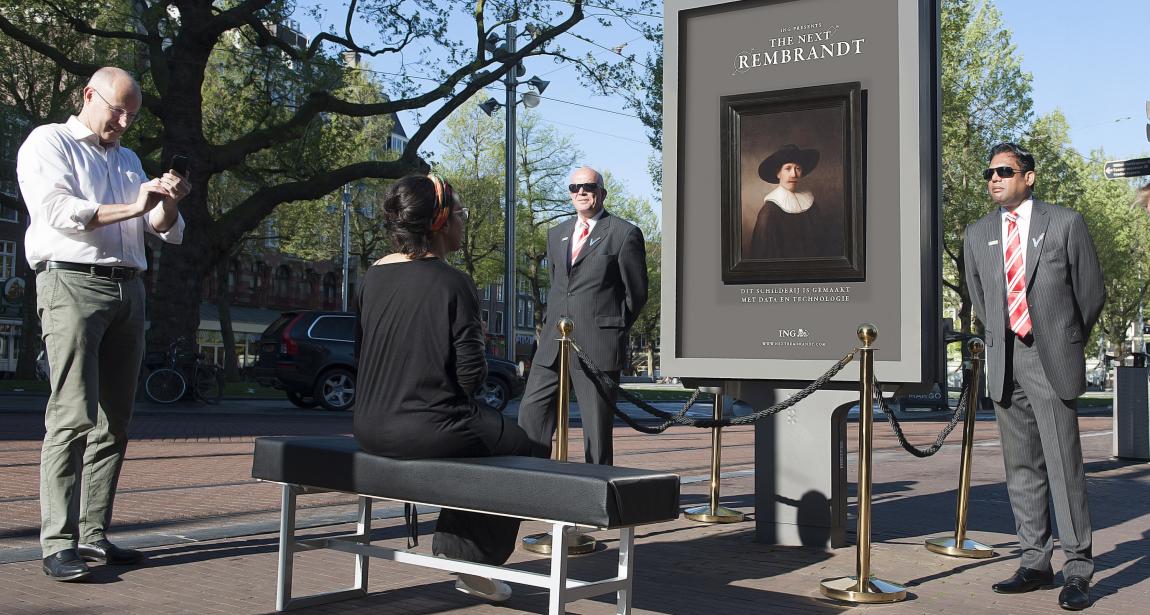
ING's 11 May 2016 announcement says The Next Rembrandt was unveiled on 5 April and then toured Dutch cities in illuminated outdoor displays. It describes deep-learning algorithms and facial-recognition techniques applied to 346 known Rembrandt paintings, followed by a 3D-printed portrait. ING names JWT Amsterdam, Microsoft, university and museum partners alongside the bank.
The public work was not just a visualization of a technical process. The portrait, and then its staging in streets, gave people a physical object around which to have the authorship conversation. That is the advertising execution this archive records.
Our reading: make the output carry the proposition
The most persuasive choice was to let the result be inspectable. A claim that a model had learned an artist's style would be abstract; a framed portrait in an outdoor cabinet makes the claim concrete enough to admire, doubt or discuss.
This is a useful pattern for technical brands: build an artifact that embodies the proposition, then give it a setting where ordinary attention can reach it. The artifact must still earn that attention. A complicated process alone does not make a relevant brand idea.
Credit the system without flattening the contributors
The ING account explicitly names data scientists, developers and Rembrandt experts. That matters because the public shorthand ‘AI made a Rembrandt’ obscures choices about the corpus, subject, style constraints, printing and exhibition. Those choices are the work that made the result legible.
For a related campaign, a compact methods note can improve the story rather than weaken it: what inputs were licensed or permitted, what the model was asked to do, and what experts decided afterward. The goal is not to turn an ad into a lab paper; it is to avoid a magical claim of autonomous authorship.
Evidence boundary: cultural attention is not product proof
The primary announcements establish the dates, partners, technology description and outdoor rollout. They do not provide a public controlled measure connecting the work to brand preference or business outcomes.
Treat The Next Rembrandt as an unusually clear example of AI-led cultural communication, not proof that a generated cultural object will deliver the same value for every sponsor.
Sources & limits
ING and JCDecaux announcements document the project and touring display; they are not independent evidence of brand effect.
- ING Newsroom — The Next Rembrandt on tour — 11 May 2016.
- JCDecaux Netherlands — ING exhibits The Next Rembrandt — 9 May 2016.
Send a correction with the passage and supporting source.