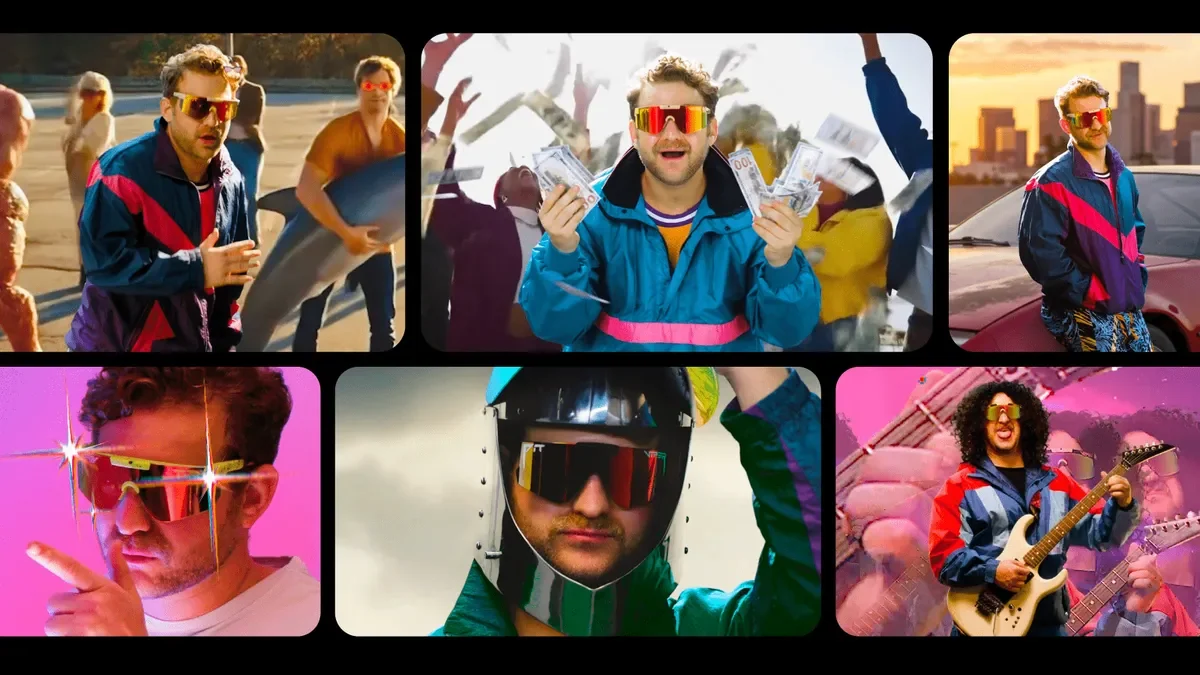
Reported production: ordinary achievement gets a strange world
Think with Google's March 2025 account describes DEPT using Gemini and Veo 2 for a Pit Viper campaign launched shortly before the Super Bowl. The creative widened performance beyond extreme sport through deliberately comic scenarios. The account describes human concept selection and detailed prompting, rather than an unbriefed system independently discovering the brand's voice.
Our reading: surrealism still needs discipline
The challenge with impossible imagery is not making one surprising frame. It is giving a series of surprises a shared reason to exist. A useful absurdist campaign needs a rule the audience can sense even when it cannot predict the next scene. Otherwise the advertisement becomes a compilation of unrelated demonstrations.
The montage supplies a clear visual anchor: conspicuous sunglasses recur amid changing situations. Our reading is that this stability helps the product survive the joke. For a similar brief, we would protect recognizable product geometry and a consistent comic attitude before expanding the number of settings. The world can be unreasonable; the brand connection cannot be arbitrary.
Direct the choices, not just the prompt
A generative workflow creates a selection problem as much as an image problem. We would ask a creative team to write the joke in one sentence before exploring variants. Each candidate then has something to answer to besides novelty. Does it sharpen that idea, change its meaning or simply add another visual detour?
Reviewing a sequence also requires different questions from reviewing a still. An arresting frame may fail when timing, continuity and the next cut enter the picture. Set aside time for those judgments and for correcting the elements that must remain dependable. These are production recommendations drawn from our reading of the format, not a claim that we observed DEPT's internal approval process.
Evidence boundary: do not inherit bad arithmetic
The provider's account reports reach, recall and a 400% decrease in production time. A reduction greater than 100% is not interpretable as an ordinary time saving. We do not reproduce it as a valid efficiency result.
Request actual start and finish dates, a comparable baseline and the scope of work included. Likewise, separate media exposure from the contribution of the generated creative. The case is valuable as a documented experiment in directing a comic brand world. It is not a controlled demonstration that an AI workflow is automatically faster or more effective than another production route.
Sources & limits
Technology-provider case study; reported metrics and timeline claims not independently verified
Send a correction with the passage and supporting source.