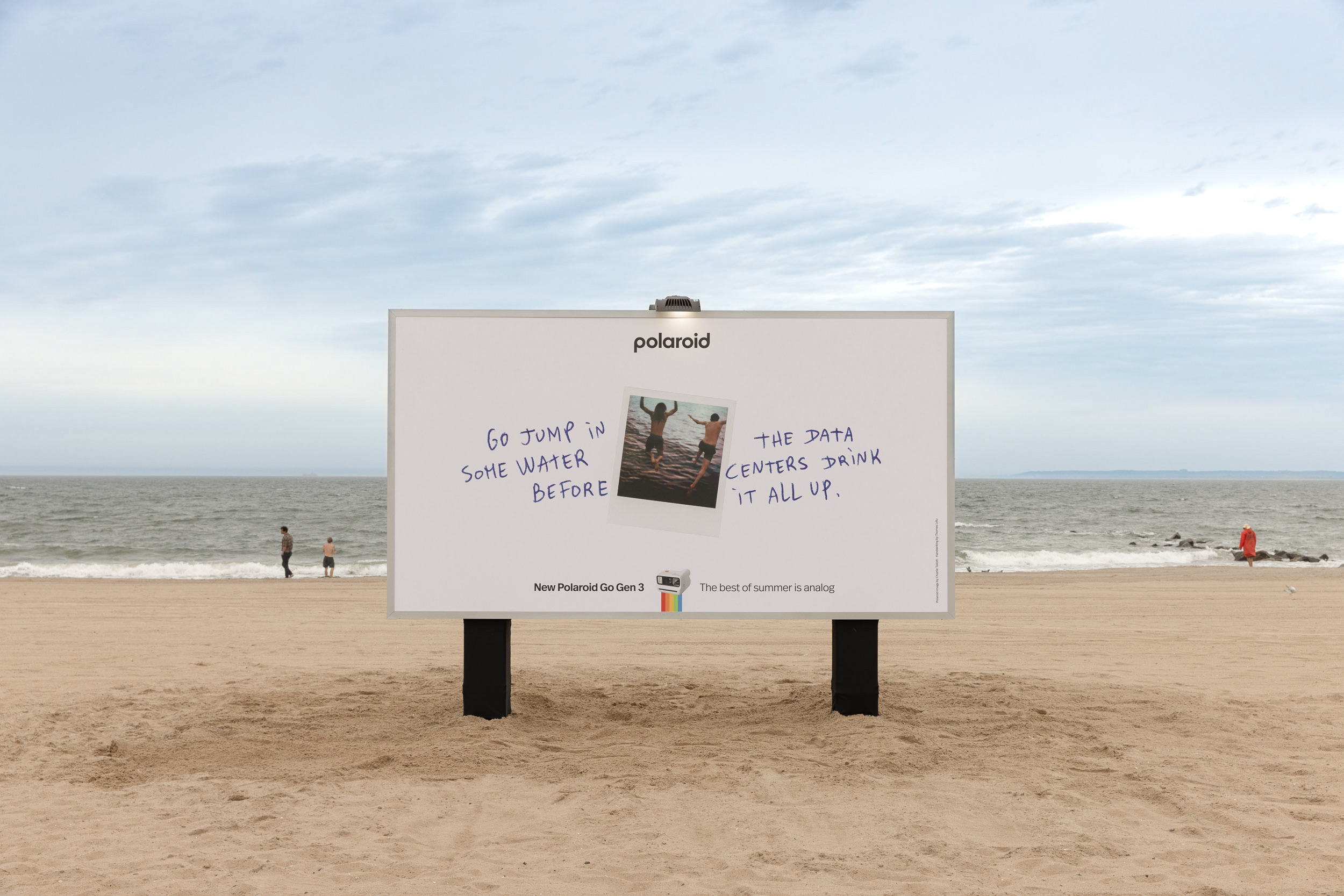
Reported execution: put the counter-message in the physical world
Polaroid’s newsroom describes a Coney Island billboard carrying the line ‘Go jump in some water before the data centers drink it all up.’ The installation launched the Best of Summer Is Analog campaign for the Polaroid Go Generation 3 and sat inside a wider OOH rollout across New York, London and South Korea.
Other lines—such as ‘You can’t bask in blue light’—extend the same idea into stations and city placements. The campaign also included a miniature summer-garden seeding experience for influencers and media.
Our reading: specificity keeps a cultural stance from becoming a lecture
The campaign does not argue abstractly about whether technology is good or bad. It puts a funny, slightly alarming sentence in a place where water, heat and bodies are already present, then offers a camera as a small route back to tangible experience.
That is a useful model for brands responding to AI culture: ground the position in a product truth and a recognizably human scene. The stance is easier to remember because the medium carries part of the argument.
Production lesson: let the placement do semantic work
A short line can carry more weight when the location supplies context. Beach, station and street placements each turn the same theme into a different physical interruption, while the real photographs and hand-rendered feel keep the work from looking like a generic anti-tech manifesto.
The broader lesson is to write for the place, not merely resize a master ad. A campaign about attention should make the audience look up, notice the setting and understand why that setting was chosen.
Evidence boundary: a memorable stunt is not a causal sales claim
The Polaroid release establishes the message, campaign locations, creative credits and connection to the Go Generation 3 launch. It does not independently measure attention, camera sales or changes in attitudes toward AI and digital life.
This record treats the work as a documented cultural-positioning campaign—an example of using analog product truth to answer the AI era—not as proof that anti-digital messaging produces a particular commercial outcome.
Sources & limits
Polaroid’s newsroom release dated 18 June 2026 documents the campaign, locations, message and credits; it does not provide an independent effectiveness study.
- Polaroid Newsroom — Polaroid drops another provocative reminder that the best of life is analog — 18 June 2026.
- Digital Camera World — Polaroid’s anti-AI billboard — 18 June 2026.
Send a correction with the passage and supporting source.