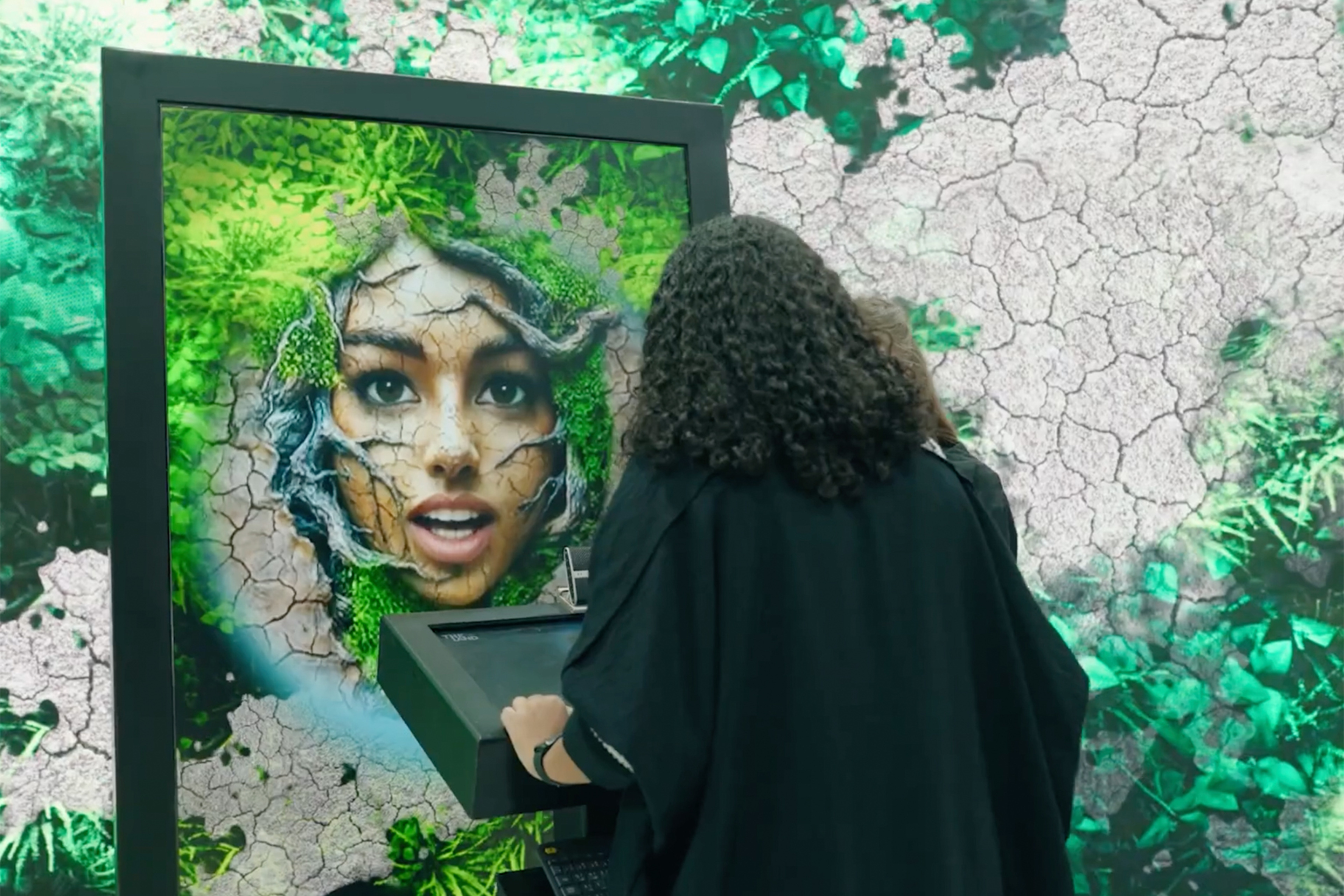
Reported execution: a conference character answered back
WPP describes The Land’s Voice as an AI-powered MetaHuman introduced at UNCCD COP16. It says the character drew from decades of environmental data, scientific studies, described Indigenous-knowledge inputs and real-time conversation models, then held two-way conversations in English and Arabic in the Green Zone. The work also extended across out-of-home, earned and social communication.
The activation treated a policy subject as a conversational presence rather than a static explainer. That is a distinctive use of AI in public-interest advertising: the interface itself was part of the message, not merely a production shortcut for the surrounding campaign.
Our reading: empathy is a bridge, not an evidence standard
Giving land a face can make desertification feel less abstract, especially in a busy event environment. But a responsive character can also encourage audiences to grant it more authority than a campaign installation deserves. Emotional immediacy should open a path to sources, not replace them.
The bilingual interaction is meaningful only if answer quality, vocabulary and local context are evaluated in both languages. A polished persona is not a substitute for subject-matter review or for affected communities’ agency in how their knowledge is represented.
Production lesson: provenance must travel into the answer
Build the knowledge base with identifiable source classes and review routes for uncertain queries. Where material is attributed to Indigenous communities, participation, permission and contextual safeguards should be established before a model turns it into a general-purpose reply; the public case does not specify those arrangements.
The experience should make its limits legible: it is a campaign conversation, not a scientific assessment or a representative voice for a place or people. Escalation to UNCCD resources and human experts belongs in the interaction design.
Evidence boundary: reach is not policy influence
WPP reports campaign outcomes, but those agency figures do not independently establish changes in public understanding or policy. The cited page is strong evidence that the MetaHuman interaction and media campaign occurred, not a longitudinal evaluation of their effect.
Its archive value is the operational design: a branded public-interest experience used conversation models to make a technical issue discussable. The harder standard is whether that conversation remains accurate, accountable and useful once the event floor disappears.
Sources & limits
WPP agency case study; its stated knowledge sources and results are campaign descriptions, not an independent scientific or governance audit.
- WPP — Burson: UNCCD’s The Land’s Voice — source publication date not stated.
Send a correction with the passage and supporting source.