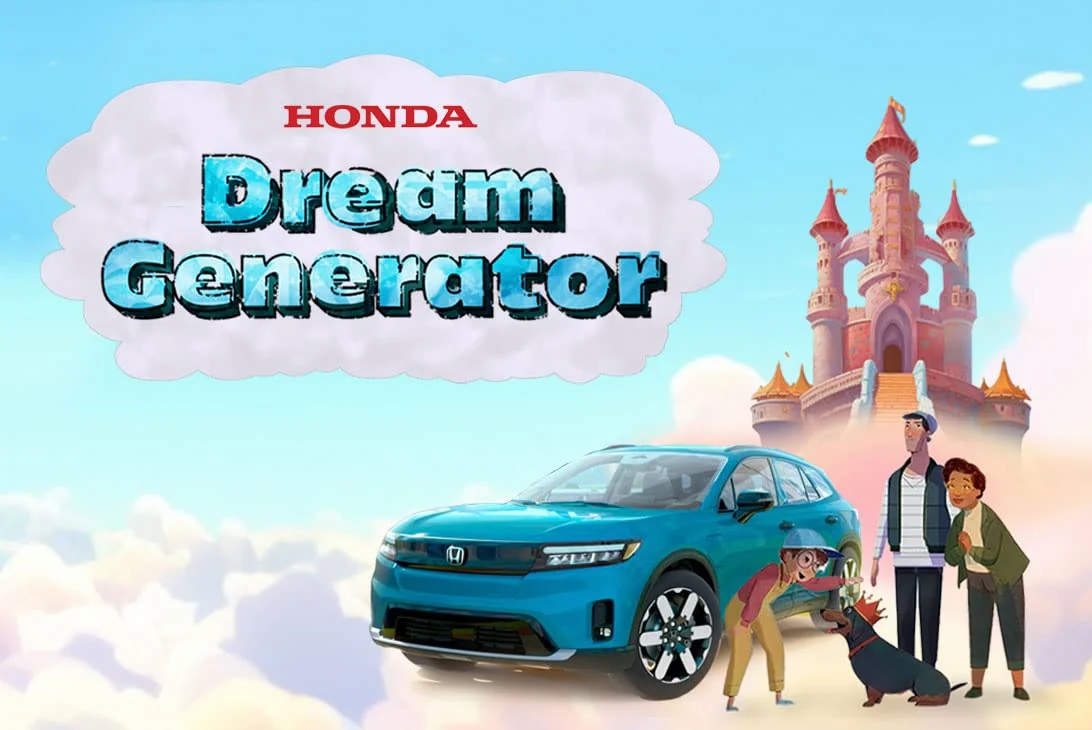
A useful interactive brief starts with a choice someone can understand. Honda’s Dream Generator invited people to select ingredients for a short animated adventure featuring the Prologue. The interest lay in seeing what those choices became. Participation had a destination.
What the source records
Amazon Ads describes a campaign developed with its Brand Innovation Lab for the 2024 Prologue. Viewers selected characters, settings, and props; the system assembled an adventure film. The experience was distributed across Amazon surfaces including Fire TV, mobile, and desktop. The production account names illustrators, animators, 3D artists, directors, and AI developers working with 1stAveMachine. Read Amazon’s account.
That account also reports improvements in brand measures and cites a Latitude study. It does not establish how much of any effect came from generative production, the invitation to participate, the media placement, or the product launch itself.
The decision worth borrowing
The creative task is to make a small choice feel consequential. A menu of settings can establish tone before the first frame plays. A prop can become a recurring joke. A character selection can give the viewer something to recognize when the finished film arrives. These are familiar storytelling tools, even when the assembly system is new.
For a team writing its own brief, the hard question is whether each choice changes the experience enough to justify asking for it. If every answer produces almost the same film, the invitation becomes busywork. If every answer produces an unrelated film, the brand loses the structure that makes the exercise readable.
Briefing question: What should remain recognizable across every branch, and what should the participant be able to change?
Work that survives automation
Write the common story in plain language before describing the generator. Decide where the product appears, which claims can be made, and what brings the film to an end. Then define the flexible parts. A branch should be a purposeful variation on the idea, with enough room for surprise and enough continuity to feel like the same campaign.
Review the seams as carefully as the individual scenes. A delightful opening can still lead to a confusing handoff. A striking frame can interrupt the rhythm of the sequence. Someone needs to own those transitions, including the moment the experience asks the viewer to share, restart, or visit a product page.
What to put in the evaluation brief
Separate completion of the experience from comprehension of the message. A person can enjoy a toy without remembering the product. Ask what they chose, whether the result reflected that choice, and whether the brand association survived the journey. Record technical failures alongside creative feedback; otherwise the people who abandoned the experience disappear from the account.
If the team wants to claim an improvement, specify the comparison before launch. Changing the media, audience, offer, and creative format together makes the result difficult to interpret. Keep the production question visible too: how much work went into approving each usable branch? The cost of rejected material belongs in that discussion.
The transferable idea is modest and demanding: give the audience a legible choice, then do enough editorial work for the response to feel considered.
Sources & limits
The campaign description comes from Amazon Ads, a participant in the work. It documents the execution; it is not an independent effectiveness audit. The briefing exercise below is our analysis, not a reported Honda process.
- Amazon Ads — Honda Dream Generator — 16 July 2024; includes the production account and brand-study reference.
Found an error? Send a correction with the passage and supporting source.