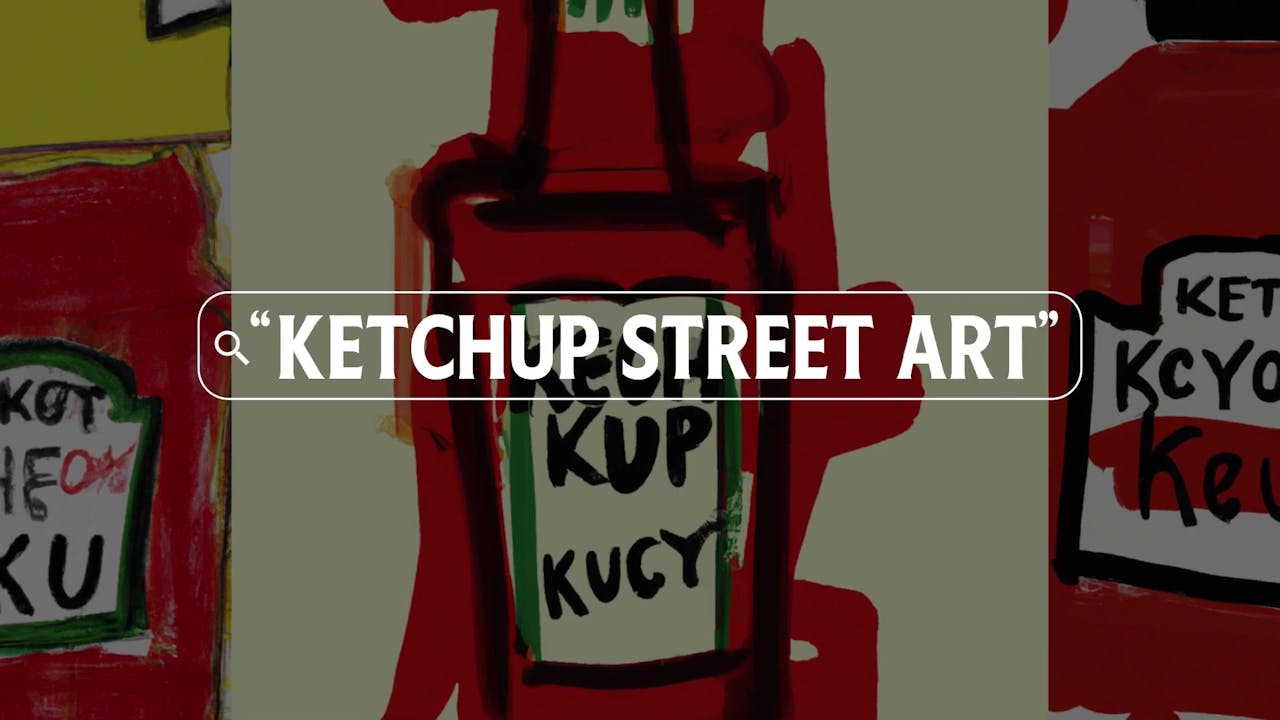
Separate recognition assets from decorative preferences
Begin with the few cues that do real recognition work: a silhouette, color relationship, product ritual, sound, verbal turn, framing habit or recurring tension. Put each cue on a card with an example, what it communicates, and the ways it can change without ceasing to be itself. ‘Use red’ is a decorative preference. ‘The bottle’s distinctive outline must read before the logo’ is a code with a job.
The One Club’s Heinz award record describes a campaign built around image generators repeatedly returning a Heinz-like ketchup bottle for the word ‘ketchup.’ Treat that as a cultural premise, not proof that an AI can protect every brand. Its practical lesson is earlier in the process: start with an association people already bring, then decide how the new execution tests it.
Source context: Kraft Heinz | A.I. Ketchup | The One Club
Write a code grammar
For every code, specify its required function, its variable range and its forbidden drift. A packaging silhouette may be required in the reveal but absent from the opening. A yellow-blue contrast may set the world while lighting, location and protagonist change. A short verbal line may be paraphrased only after a copy owner approves the local meaning. This is a grammar because it describes relationships and permissions, not a folder of images to imitate.
Ask creative teams to make three routes using the same grammar but different story engines: demonstration, juxtaposition and participation. If the routes still feel identical, the grammar is too prescriptive or the routes are only styling exercises. If none feels related, one of the claimed codes is not actually carrying recognition.
Check codes at the moments that matter
Do not use a single end-frame review for brand codes. Test the opening second, the first product encounter, the mid-film interruption, the final frame and the cropped social thumbnail. Those are different moments of recognition. A code that appears only after a viewer has scrolled past does not solve the discovery problem.
Adobe’s Lipton customer story says the team aligned color and lighting references across assets and markets. That is a useful production example of an agency-described consistency effort, but not a universal formula. Our recommendation is to record the code test separately from aesthetic approval: reviewers should be able to say a film is attractive yet fails to expose the product world at the needed moment.
Source context: How Lipton and Critical Mass crushed advertising targets with generative AI
Run a sameness audit before making more variants
Lay ten proposed outputs in a grid with names hidden. Ask reviewers to sort them by story, not by campaign. If they cannot, count the variables that genuinely changed: proposition, action, viewpoint, tension, setting, product role and ending. Different prompts that preserve all seven will create cosmetic variety, not a testable creative system.
Then keep a small code ledger. For each approved asset, mark which codes are present and which story engine it uses. The ledger reveals whether the campaign is overusing one color cue or avoiding the product altogether. It also stops a familiar failure: a model starts supplying the same fashionable lighting because no human has named the more useful thing that should vary.
Sources & evidence limits
Source-backed facts are distinguished from the editorial workflow proposed here. Brand and agency accounts document their own work, not independent proof of performance. Read the linked source for its scope.
- Kraft Heinz | A.I. Ketchup | The One Club
The case record documents the campaign’s brand-association premise and credited execution.
Checked 2026-09-19 · Source publication date not established - How Lipton and Critical Mass crushed advertising targets with generative AI
Adobe describes Lipton reference work around color palettes and lighting styles. Page displays 5 May 2026, while embedded card metadata says 2 June 2025; the displayed date is recorded here, not a verified campaign launch date.
Checked 2026-09-19 · Source published 2026-05-05