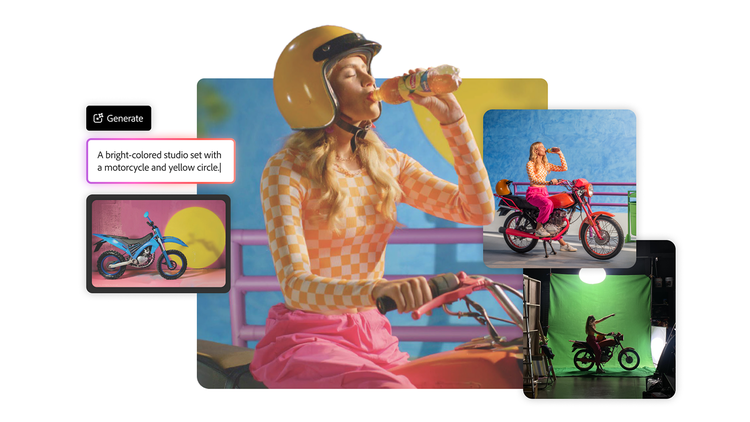
Reported execution: the model made the visual brief tangible
Adobe describes Lipton’s campaign as a multi-market launch across Latin America, with 25 stories under three campaign pillars and seven bottle designs. Firefly’s Structure Reference and Style Reference features helped the team explore composition, lighting, props and casting direction before production.
The case study says the team generated more than 100 storyboards, over 2,000 AI-driven images and 500 prompts. The final campaign used real models; generative imagery shaped the shared visual direction rather than standing in for the finished cast.
Our reading: pre-production is where the handoff becomes inspectable
The valuable artifact is not a polished synthetic person. It is the visible bridge between an exploratory image and a shoot plan: a creative team can show what it means by colour, light, motion and casting before asking a client to approve a production.
That makes the workflow easier to critique. A team can reject a reference, revise the brief or widen its casting conversation before money is committed to the shoot, while still keeping the people in the final work real and accountable.
Production lesson: keep the reference set attached to the decision
A generative previsualization library can become a fast way to hide taste decisions inside a pile of images. The better practice is to retain the selected references, the prompt or direction that made them useful, and the human reason for carrying each choice forward.
For a multi-market campaign, that record can become a lightweight visual constitution: what must stay consistent, what may localize, and what is only exploratory. The speed comes from comparison, not from treating the first plausible image as a final answer.
Evidence boundary: the performance claims remain partner claims
Adobe reports 142% of the original reach objective, a 12% complete-view rate against a 3% benchmark, and a 4.4% brand-association lift in Brazil against a 0.9% industry benchmark. Those figures are useful leads, but the public case study does not provide an independent audit or a separate first-air date.
This archive therefore uses the case-study month as a dated index anchor and separates the reported production workflow from the reported outcomes. It does not infer that the image generation alone caused the performance result.
Sources & limits
Adobe’s 5 May 2026 case study; reach, completion and brand-association figures are Adobe/agency-reported, and the page does not state a separate first-air date.
Send a correction with the passage and supporting source.