A character should have a job, not unlimited improvisation
A brand voice becomes precarious when it is asked to answer everything. The more a system sounds intimate, authoritative or human, the more easily a playful exchange can turn into an unsupported product promise, a sensitive disclosure, an unwanted endorsement or a request for help that needs a person. Define one useful job before writing personality: explain a campaign world, help find approved product information, guide a game, collect a simple preference or direct people to a real service channel.
Then state the non-jobs. The experience does not give medical, financial or legal advice; does not invent stock, pricing or availability; does not imitate a real person without a documented approved scope; does not ask for information it does not need; and does not pretend to be a human representative if that would mislead a participant. The exact list changes with the campaign. Its existence should not.
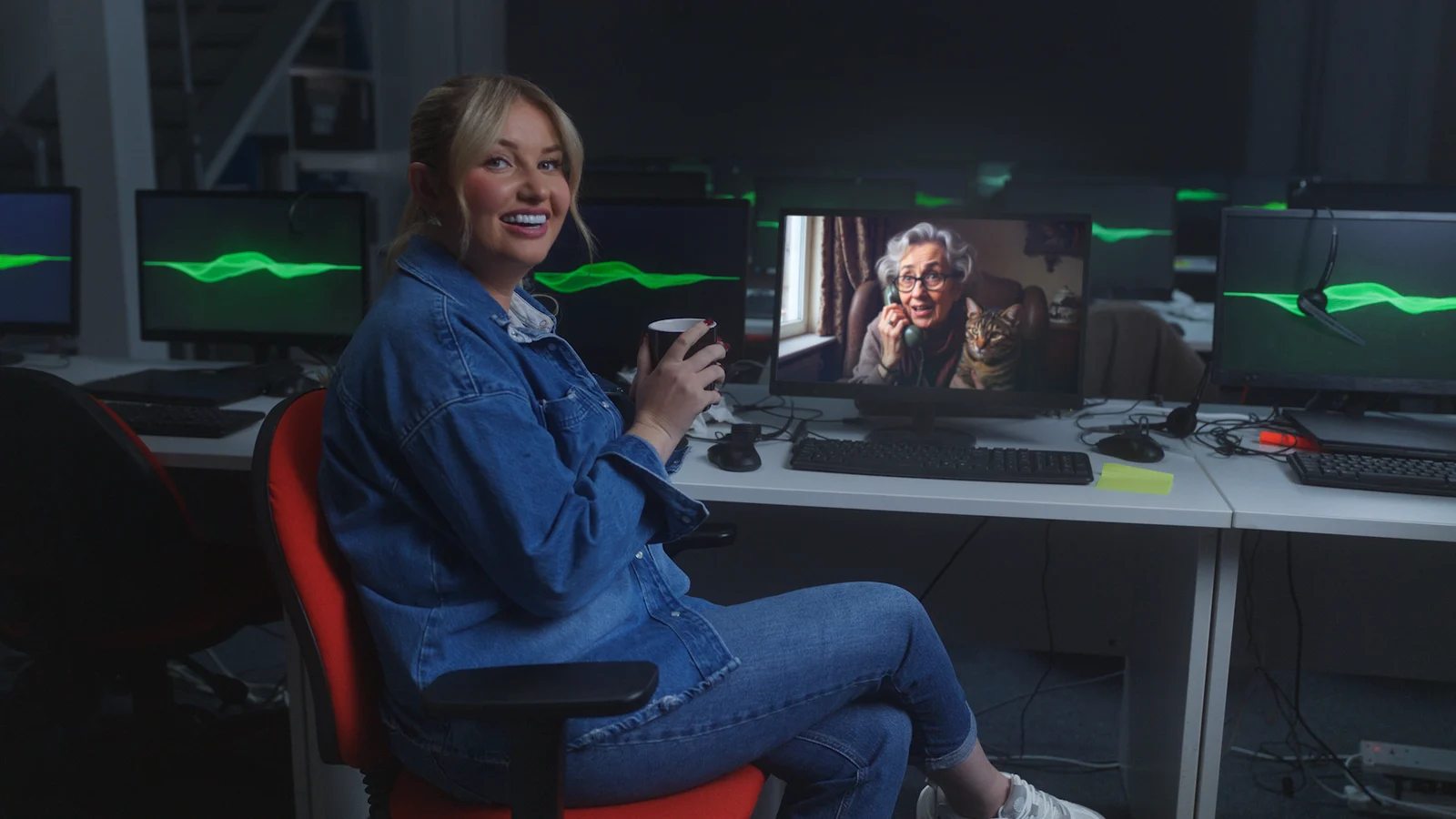
O2’s Daisy is a boundary case, not a customer-service template
Virgin Media O2’s 2024 Daisy campaign positioned an AI character to keep suspected scammers occupied and direct customers to safer reporting behavior. Its own release describes custom language-model and speech components, but its audience call to action was not ‘try scambaiting yourself’: it urged people to stay vigilant, report suspected calls and leave the activity to the experts. The campaign’s value came from a narrow adversarial purpose and a clear exit for ordinary customers.
That is the useful lesson. Do not copy the character or mechanism into a brand assistant. Copy the discipline: name the interaction’s objective, identify who should not use it, put a safe human or official route nearby, and avoid treating entertaining conversation length as proof that the experience served the user.
Source context: Virgin Media O2 — O2 unveils Daisy, the AI granny wasting scammers’ time
Write a claims boundary before the dialogue
Build a compact boundary sheet for creative, customer service, product, legal and safety owners to read together. It should include approved facts and source locations, disallowed claims, topics that trigger a handoff, phrases that make the artificial nature clear, and a recovery message for uncertainty. The recovery message is not an apology after failure; it is part of the designed voice.
Test ordinary ambiguity, not just obvious abuse. Ask for a discount that does not exist, a product comparison the team cannot substantiate, an interpretation of a campaign promise, a personal crisis, a request to contact a person, a misleading instruction and a language switch. Log failures by category. A charming response that makes up an answer is a release blocker, not a personality win.
- Start: disclose the experience’s nature and its narrow purpose in the first interaction.
- During: answer only from approved, current material; otherwise say what cannot be confirmed.
- Escalate: route claims, complaints, accessibility needs, safeguarding issues and account matters to a named human or official channel.
- End: preserve a visible exit that does not require persuading the system to let go.
Measure safety and usefulness together
Track whether people reach the intended answer or action, but do not make completion the only success signal. Also review escalation rate, unresolved requests, unsafe or unsupported responses, repeated confusion, corrections and disclosure comprehension. Read real transcripts or representative logs under the project’s approved privacy and retention practice; dashboards cannot tell you whether a response sounded falsely certain.
Our recommendation is a reversible pilot with a small, defined scope, named transcript-review owner and a pause trigger for a serious category failure. A conversation should earn wider release by being consistently useful within its boundary, not by looking impressively human outside it.
Sources & evidence limits
Source-backed facts are distinguished from the editorial workflow proposed here. Brand and agency accounts document their own work, not independent proof of performance. Read the linked source for its scope.
- Virgin Media O2 — O2 unveils Daisy, the AI granny wasting scammers’ time
O2’s stated campaign purpose, technical description and public guidance to report suspected scams rather than engage.
Checked 2026-09-19 · Source published 2024-11-14