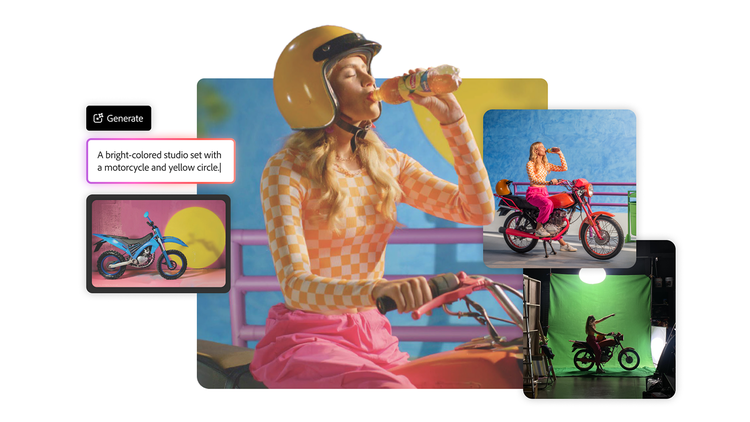
Freeze the story question before breaking frames apart
An AI exploration board is often rich in atmosphere and poor in causality. Before it becomes a shot list, write the story in four beats: what changes, who notices, what proves the change, and what the audience should do next. If a board cannot answer those questions in plain language, more frames will only make the ambiguity more expensive.
Give the board an approved reference number and circle the frames that carry a non-negotiable job: product reveal, action, emotional turn, brand sign-off. Everything else is a candidate, not a promise. This protects a crew from being asked to reproduce accidental image details that have no narrative or brand purpose.
Translate each selected frame into production facts
For every proposed shot, create one row with its narrative function, duration range, framing, camera movement, subject action, product state, setting, sound cue, transition in and transition out. Add a column called ‘must match’ and another called ‘may change.’ A still showing a motorcycle against a colored wall does not tell a production team whether the camera is tracking, whether the drink enters frame, or why the cut needs to happen.
The Lipton customer story published by Adobe describes more than 100 storyboards as early exploration and then a production using real models. The transferable point is not the output count. It is the handoff boundary: references can align a team, but final production needs a choice about what is actually shot and who owns it.
Source context: How Lipton and Critical Mass crushed advertising targets with generative AI
Make a shot list that can survive change
Label every row P for practical capture, G for generated element, C for composite, or E for editorial decision. This instantly surfaces mixed-method dependencies: a practical hand must be available before the product composite; the edit cannot lock before the sound license is known; a generated background can be replaced without reshooting talent. It is a much better conversation than arguing about whether the whole film is ‘AI.’
Order the list by production dependency, not by the final edit. Shoot product plates, clean environments, hero performance and inserts in a sequence that reduces resets, but preserve the edit order in the ID. A useful ID might be 03B-P: beat three, variation B, practical. The editor can trace the intent while the line producer can trace the work.
Run a table read for the camera department
Before the first setup, ask the director, producer, DP, art lead, product owner and editor to walk the list aloud. For each row: what would make this unuseable in the edit? What must the performer, prop or product do? What is being created later? The answer should be written beside the shot, not assumed to survive in someone’s head.
End with a minimum viable cut: the six to ten shots required to communicate the proposition if weather, timing or a generation pass fails. That is your contingency plan. It also prevents the team from spending the day acquiring decorative coverage while the key transition or product proof remains unresolved.
Sources & evidence limits
Source-backed facts are distinguished from the editorial workflow proposed here. Brand and agency accounts document their own work, not independent proof of performance. Read the linked source for its scope.
- How Lipton and Critical Mass crushed advertising targets with generative AI
Adobe describes storyboarding, visual references, casting direction and final work featuring real models. Page displays 5 May 2026, while embedded card metadata says 2 June 2025; the displayed date is recorded here, not a verified campaign launch date.
Checked 2026-09-19 · Source published 2026-05-05