Start with a decision, not an image
A request for ‘AI ideas’ usually hides a decision that has not been made. Is the team trying to make a product easier to understand, find a film world, test a regional expression, or produce a larger version set? Those are different jobs. Until the job is named, a generator may return a handsome mixture of all of them, and the review meeting will mistake volume for progress.
Write one decision sentence first: ‘Choose whether the launch should lead with the product’s quiet usefulness or its technical novelty.’ Then add the audience situation, the evidence the audience needs, and the action the work should make easier. This leaves room for imagination without asking the model to supply the strategy. It also gives a producer a way to decline routes that are visually good but solve the wrong problem.
- Decision: what must the team choose or learn?
- Audience moment: what is happening when this message arrives?
- Proof: what fact, product behavior or feeling must survive the execution?
Build a constraint card people can actually use
Keep the working card to one page. Separate fixed constraints from creative invitations. Fixed constraints are a locked claims sheet, product reference files, approved names, dates, territories, people who cannot be depicted, and the channels that matter. Invitations are the tension, sensory cues, cultural territory and emotional turn worth exploring. Mixing these lists is how a brand winds up treating its factual limits as optional aesthetic notes.
Name an owner beside every constraint. ‘Packaging: product lead’; ‘performance claim: regulatory lead’; ‘casting reference: producer’; ‘final brand code: creative director.’ A constraint without an owner becomes an argument delayed until finishing. Make the kill criteria explicit too: wrong product geometry, borrowed artist likeness, a claim not in the source pack, or an idea that needs an explanation longer than the asset.
- Locked: facts, assets, prohibited claims, clearance limits and delivery formats.
- Flexible: setting, metaphor, edit rhythm, camera language and casting direction.
- Decision gates: concept selection, previsualization approval, production lock and release.
Prompt from approved material, then preserve the rejection
Only after the card is agreed should someone make prompts. Give the operator a bounded source pack and ask for routes, not finals: each route must state the chosen tension, the reference assets used, the parts that are illustrative, and the reason it might fail. That converts prompting into a documented exploration method rather than a private source of mystery images.
Our recommended workflow is to keep a short rejection log beside the chosen route. Record the route ID, why it was rejected, and whether the cause was strategy, craft, rights, product fidelity or tool behavior. The log prevents teams from paying twice for the same dead end and makes a later brief sharper. It is not a creativity scorecard; it is a record of judgment.
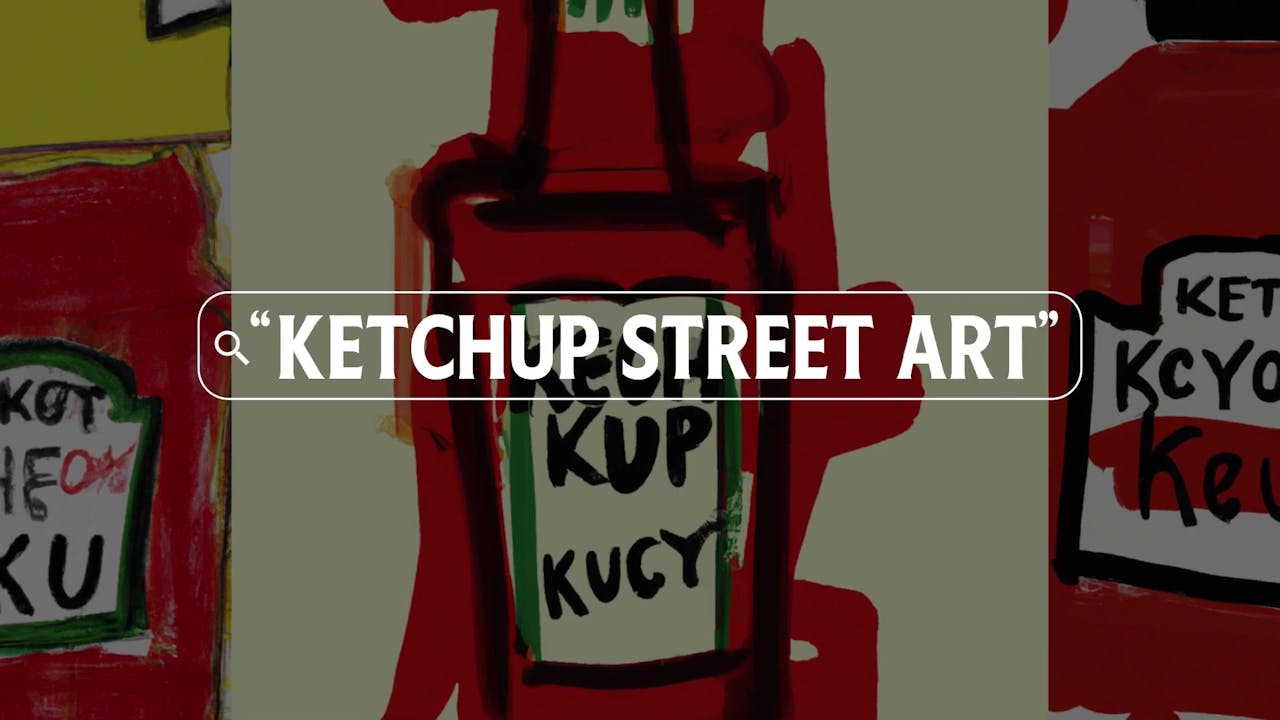
Source context: Kraft Heinz | A.I. Ketchup | The One Club · How Lipton and Critical Mass crushed advertising targets with generative AI
Use this ten-minute kickoff worksheet
Ask the room to fill these blanks before exploration: ‘For [audience] in [moment], make [decision or action] easier by showing [approved product truth or human insight]. The work must feel [three concrete qualities], must not imply [three prohibited ideas], and will be judged by [three review tests].’ If the group cannot complete a blank, that is work to do before prompting—not an invitation to generate around the uncertainty.
One practical test follows: remove the words ‘AI’ and ‘prompt’ from the card. If the assignment becomes meaningless, the technology has become the objective. If it still describes a precise communication problem, AI has a chance to be a useful means rather than the campaign’s premise.
Sources & evidence limits
Source-backed facts are distinguished from the editorial workflow proposed here. Brand and agency accounts document their own work, not independent proof of performance. Read the linked source for its scope.
- Kraft Heinz | A.I. Ketchup | The One Club
The award record identifies the campaign brief, DALL-E 2 experiment and credited production roles.
Checked 2026-09-19 · Source publication date not established - How Lipton and Critical Mass crushed advertising targets with generative AI
Adobe's customer story describes reference-led early concept work and a later live-action production. Page displays 5 May 2026, while embedded card metadata says 2 June 2025; the displayed date is recorded here, not a verified campaign launch date.
Checked 2026-09-19 · Source published 2026-05-05