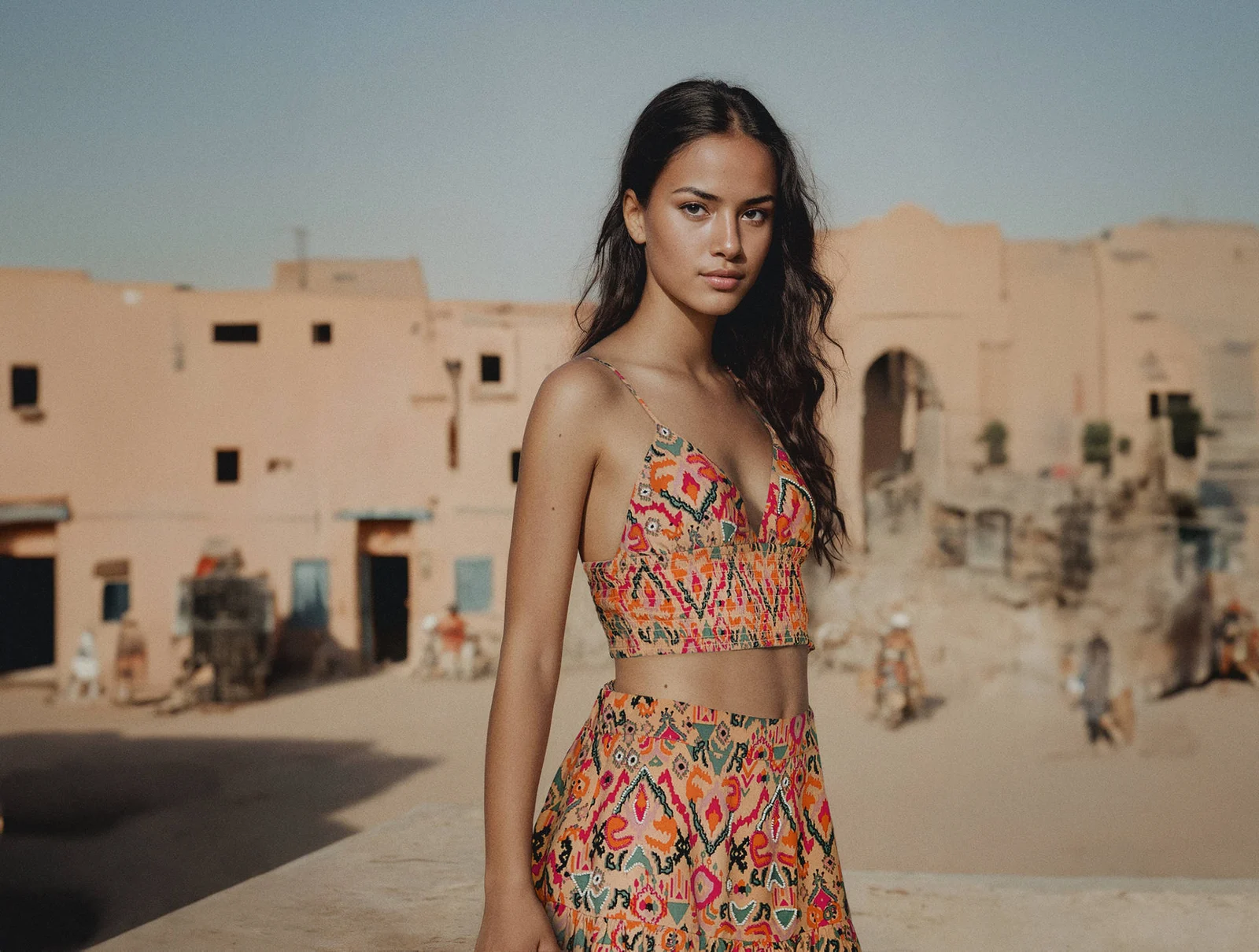
Reported execution: a generated image still began with the product
Mango's July 10, 2024 press release presents Sunset Dream as the first campaign made entirely with generative AI for its Mango Teen line. Rather than asking a model to invent a collection from a text prompt, the company says the workflow began with real photographs of each limited-edition garment. A generative model learned to position those garments on a model, producing the campaign imagery for a collection described as available in 95 markets.
The release also identifies the teams around the model: design, art, styling, dataset and AI-model training, and the photography studio. After generation, Mango says its art team selected, retouched, edited and mastered the images. That sequence matters. The source does not describe autonomous product photography; it describes a fashion-image pipeline in which the source garment, final selection and finishing remained deliberately managed.
Our reading: fidelity is the creative constraint, not a technical footnote
Fashion imagery is unusually exposed to the gap between a compelling picture and a purchasable item. The useful ambition here is not simply to make a synthetic scene look glossy. It is to keep the article of clothing recognisable while changing the way it is staged. Starting from real garment photographs makes that constraint explicit and gives the creative team something concrete to inspect.
That does not settle whether every published image perfectly represents colour, drape, fit or construction. It does establish a better editorial frame than treating an AI fashion visual as an unconstrained mood board. The campaign's craft claim is most credible where the image remains accountable to the item a customer can actually find.
Production lesson: separate the reference asset from the selected image
A comparable brief should preserve a product-reference set and make clear which features cannot drift: fabric pattern, silhouette, colourway, trims and sizing cues. Reviewers need a simple side-by-side route before approving an output for commerce, social or editorial use. The retained source photographs also make it possible to correct a representation without restarting a campaign from an ambiguous prompt.
Selection should be treated as a named production stage, not a final click. Record who can approve an image, what retouching changed, and whether an image is illustrative or product-exact. This is especially important when an asset moves from campaign atmosphere to a purchase page, where a beautiful but inaccurate image becomes a product claim.
Evidence boundary: Mango describes its process, not its commercial effect
The Mango release supports the campaign date, the stated real-photo training input and the stated human finishing steps. It does not disclose the model, training rights, error rates, approval criteria, production time, cost, or independent evidence that viewers found the imagery more effective. This record therefore avoids claims about efficiency, sales or environmental savings.
A stronger later evaluation would compare approved outputs with garment references, catalogue the kinds of corrections needed, and test whether shoppers can accurately understand the product from each visual. The durable lesson is narrower: when AI enters apparel imagery, product fidelity needs an explicit production owner from source photo through final art direction.
Sources & limits
Mango's contemporaneous press release documents its stated production process and release; it is not an independent assessment of the system, consumer response, or product-image fidelity.
- Mango — Mango creates the first campaign generated by artificial intelligence for its Teen line — 10 July 2024.
Send a correction with the passage and supporting source.