Choose the method after the proof requirement
Live action is usually strongest when the audience must trust a specific performance, material behavior, location, person or product interaction. It gives the team a capture event it can inspect and releases it can scope. It still needs claims, talent, safety and post-production review; its advantage is not automatic truth, but a more direct chain to the thing being shown.
AI-assisted production is often strongest for speculative worlds, early visual alignment, non-final motion studies, environments that are impractical to capture, modular backgrounds, and controlled version exploration. It becomes less attractive when the work relies on a product’s exact behavior, a recognisable person, an emotionally specific performance or a claim the audience is likely to take literally.
Compare the operating trade-offs
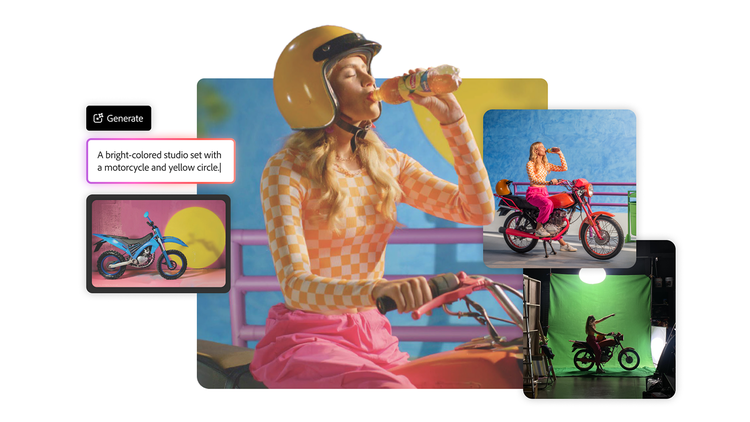
Use a simple comparison in the kick-off. AI can widen routes early but may introduce consistency, source-rights, cleanup and audit work. Live action can narrow uncertainty through a controlled shoot but commits you to casting, location, crew, schedule and reshoots. A hybrid can keep the proof-bearing layer practical while using AI for previsualization, compositing exploration or version support, but it needs a clear boundary so the final asset is not falsely described.
Adobe’s Lipton customer story describes generated visual references informing casting and production, while only real models appeared in the final campaign. That is one vendor-published case, not a rule. It is nevertheless a clean example of the question to ask: which layer benefits from generation, and which layer should remain in the controlled production record?
Source context: How Lipton and Critical Mass crushed advertising targets with generative AI
Use a four-question decision sheet
First: what must be literally true on screen? Second: what will a skeptical viewer inspect or rely on? Third: what source material and permissions do we actually control? Fourth: what needs to be changed after the first release? Score each answer as low, medium or high risk. High literal-truth or audience-reliance risk points toward practical capture or a locked practical layer. High iteration need with low literal-truth risk may justify generated exploration or a hybrid.
Do not turn the sheet into a formula. A restrained live-action shot can be cheaper to approve than an elaborate synthetic alternative, but no universal rate follows from that. The point is to expose the costs that sit behind the method: review, reshoots, cleanup, licensing, version QA and post-release correction.
Write the production declaration before work begins
For the chosen route, write one sentence the team would be comfortable using in a release note: ‘Real performers and product plates were filmed; AI-assisted background exploration informed selected composites,’ or ‘This asset uses generated imagery for an illustrative world; product specifications were separately verified.’ If the team cannot write this accurately before production, the boundary is not understood well enough to approve.
Keep the declaration internal until the disclosure approach is reviewed for the actual market and channel. Its first purpose is operational honesty: it tells the editor what evidence to retain, tells media what not to imply, and tells a future producer what can and cannot be reused.
Sources & evidence limits
Source-backed facts are distinguished from the editorial workflow proposed here. Brand and agency accounts document their own work, not independent proof of performance. Read the linked source for its scope.
- How Lipton and Critical Mass crushed advertising targets with generative AI
Adobe states that final Lipton campaign models were real while generated imagery informed earlier direction. Page displays 5 May 2026, while embedded card metadata says 2 June 2025; the displayed date is recorded here, not a verified campaign launch date.
Checked 2026-09-19 · Source published 2026-05-05 - Mango creates the first campaign generated by artificial intelligence for its Teen line
Mango describes a finished fashion campaign generated from real garment photographs and human finishing.
Checked 2026-09-19 · Source published 2024-07-10